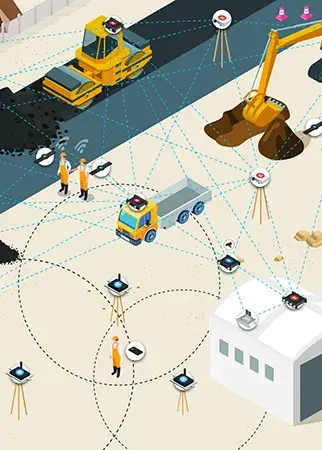
Remote and mobile worksites depend on reliable connectivity to keep people, equipment, cameras, sensors, and other critical technologies connected. But when operations extend beyond the reach of traditional network infrastructure or reliable cellular coverage, maintaining that connection can be a challenge.
Rajant Kinetic Mesh® provides a different approach: a private wireless network designed to move and adapt with your operation.This article will explain how Kinetic Mesh works and why it can serve as a “cell tower on wheels” for connected worksites.
What is Rajant Kinetic Mesh?
Rajant Kinetic Mesh® is a secure, self-healing private wireless mesh network designed for mobile, industrial, and mission-critical environments. Rugged BreadCrumb® wireless nodes use Rajant’s InstaMesh® software to communicate peer-to-peer across multiple connections. Nodes can be installed on fixed infrastructure or moving assets, allowing the network to adapt as equipment, vehicles, and people move.
Similarly to a cellular network, Kinetic Mesh provides wireless connectivity across a broad area, but without the same dependence on fixed towers, centralized infrastructure, or handoffs between cells.
View Rajant Kinetic Mesh solutions →
What industries benefit from mobile connectivity at remote worksites?
The need for reliable mobile connectivity extends across industries where operations are remote, spread across large areas, or constantly changing. Rajant Kinetic Mesh supports a wide range of environments, including:
|
INDUSTRY |
ENVIRONMENTS AND JOBSITES |
|
Mining |
Open-pit and underground mines, haul roads, drilling sites, processing areas, and other remote mining operations |
|
Highway projects, earthmoving sites, large infrastructure projects, temporary jobsites, and remote construction areas |
|
|
Substations, transmission and distribution sites, generation facilities, field operations, and other remote utility locations |
|
|
Water and wastewater |
Treatment facilities, pump stations, reservoirs, collection systems, and other distributed infrastructure |
|
Rail yards, fleet yards, ports, terminals, distribution centers, and large outdoor logistics operations |
|
|
Manufacturing plants, warehouses, distribution facilities, outdoor storage yards, and large industrial campuses |
|
|
Large farms, fields, livestock operations, agricultural facilities, and other remote or expansive agricultural environments |
|
|
Emergency scenes, disaster areas, mobile command locations, temporary security areas, and other rapidly deployed environments |
While the applications vary, these environments share a common need: keeping people, equipment, and technology connected wherever the work takes them.
What can you connect with Rajant Kinetic Mesh?
Rajant Kinetic Mesh provides the network infrastructure that allows devices, equipment, and systems across a worksite to communicate. Depending on the operation or industry, that can include:
- Video surveillance cameras
- Rugged computers and tablets, including TOUGHBOOK® devices
- Wi-Fi-enabled two-way radios
- Access control systems
- License plate recognition (LPR)
- GPS and positioning systems
- SCADA and remote monitoring systems
- Sensors and industrial IoT devices
- Equipment telemetry and asset tracking systems
- Autonomous vehicles and heavy equipment
- Drones and robots
- Machine-to-machine communications
Rather than serving as any one of these applications, Kinetic Mesh provides the connectivity that brings them together across the operation.
Why does traditional connectivity fall short on remote worksites?
Modern jobsites increasingly depend on connected technologies. The challenge is that many of these assets are mobile, while the network infrastructure serving them is traditionally fixed.
That mismatch creates multiple challenges:
- Limited cellular coverage: Remote worksites may have weak, inconsistent, or no public cellular coverage.
- Limited network infrastructure: Extending fiber or installing other permanent infrastructure across remote, temporary, or rapidly changing sites can be difficult and costly.
- Distance: Large and sprawling operations can extend beyond the practical coverage of traditional Wi-Fi networks.
- Physical obstructions: Terrain, buildings, equipment, stockpiles, and other obstacles can interfere with wireless connections.
- Constantly moving assets: Vehicles, machines, equipment, and personnel may move throughout the site and beyond the coverage of fixed network infrastructure.
- Changing operations: Construction projects, mines, utilities, and other operations can expand or shift into new areas, changing where connectivity is needed.
- Growing bandwidth demands: Video, telemetry, sensors, automation, and connected equipment can place increasing demands on the network.
- Network disruptions: Reliance on a single access point, connection, or communication path can leave operations vulnerable when that link becomes unavailable.
- Scalability: Adding vehicles, devices, equipment, or coverage areas may require additional infrastructure or network redesign.
These challenges call for a different approach to worksite connectivity. That’s where Rajant Kinetic Mesh comes in.
How does Rajant Kinetic Mesh work to create a “cell tower on wheels”?
Rajant Kinetic Mesh works with the help of Rajant BreadCrumb® nodes. These are rugged wireless devices that serve as the building blocks of a Kinetic Mesh network, connecting with other nodes to send and receive data across the network.
This decentralized architecture also makes Kinetic Mesh self-healing. If a connection becomes unavailable, Rajant’s InstaMesh software can automatically identify another available path for data to travel, helping maintain connectivity without manual intervention.
The nodes can be mounted on vehicles, heavy equipment, trailers, buildings, poles, and other fixed or mobile assets. When installed on a vehicle or machine, that asset becomes part of the network as it moves throughout the site, effectively taking network infrastructure along for the ride.
This mobility changes how coverage can be deployed and maintained across a worksite:
- Brings connectivity where the work is happening. Mobile BreadCrumbs can travel with vehicles and equipment into areas where fixed infrastructure may not provide adequate coverage.
- Adapts as the worksite changes. As equipment moves, projects advance, or operations expand into new areas, the network can adjust without requiring coverage to remain anchored to the same locations.
- Expands the network as needed. Additional BreadCrumbs can be deployed on fixed or mobile assets to extend the network into new areas or support growing operations.
That’s the idea behind a “cell tower on wheels”—instead of designing operations around the reach of fixed network infrastructure, organizations can deploy network infrastructure on the assets already moving throughout the worksite.
When should you consider Rajant Kinetic Mesh instead of traditional Wi-Fi or cellular?
Traditional Wi-Fi and public cellular networks work well for many applications, but they aren’t designed for every industrial environment. Rajant Kinetic Mesh may be a better fit when your operation requires:
- Continuous connectivity for moving assets: Vehicles, heavy equipment, and other mobile assets need to stay connected as they travel throughout the site.
- Coverage that can change with your operation: The network needs to expand, move, or adapt as projects and operational requirements change.
- Connectivity across challenging environments: Large distances, rugged terrain, physical obstructions, or remote locations make conventional network coverage difficult.
- Greater network resiliency: Critical operations cannot depend on a single access point or communication path.
- Support for data-intensive applications: Video, telemetry, automation, and other applications require reliable network performance.
- A secure, private network built around your operation: You need greater control over how and where connectivity is deployed.
Kinetic Mesh does not necessarily have to replace your existing network infrastructure. Depending on the application, BAYCOM can integrate Rajant with technologies such as fiber, microwave, Wi-Fi, and private LTE to create a network designed around the needs of your operation.
Build a network that works where your operation works
Every worksite presents different connectivity requirements. BAYCOM can evaluate your environment, coverage and bandwidth needs, connected technologies, and operational priorities to determine whether Rajant Kinetic Mesh is the right fit and how it can work with your existing infrastructure.
From network design and deployment to ongoing service and support, BAYCOM works with you to build a reliable connectivity solution for the long haul.
Ready to improve connectivity across your operation? Explore solutions and talk to a BAYCOM network expert about Rajant Kinetic Mesh.
Frequently asked questions: Rajant Kinetic Mesh Network
What is a Kinetic Mesh network?
A Kinetic Mesh network is a secure, private wireless mesh network designed to maintain connectivity in environments where people, vehicles, equipment, and network infrastructure may be moving. Rajant Kinetic Mesh® uses BreadCrumb® nodes and InstaMesh® software to create multiple communication paths between nodes.
How is Rajant Kinetic Mesh different from Wi-Fi?
Traditional Wi-Fi typically connects devices through fixed access points. Rajant Kinetic Mesh allows BreadCrumb nodes to communicate peer-to-peer, with multiple potential paths for data to travel. This makes it well suited for large, mobile, or changing environments where relying solely on fixed access points can be limiting.
Does Rajant Kinetic Mesh require cellular service?
No. Rajant Kinetic Mesh creates a private wireless network and does not depend on public cellular coverage to connect devices within the mesh. It can also be integrated with other network infrastructure when outside connectivity is required.
Can Rajant Kinetic Mesh work with an existing network?
Yes. Kinetic Mesh does not necessarily need to replace existing infrastructure. Depending on the application, it can be integrated with fiber, microwave, Wi-Fi, private LTE, and other network technologies.
Can Rajant Kinetic Mesh connect moving vehicles and equipment?
Yes. BreadCrumb nodes can be installed on vehicles, heavy equipment, and other mobile assets, allowing those assets to participate in the network as they move throughout an operation.
What devices and systems can connect to Rajant Kinetic Mesh?
Kinetic Mesh can provide network connectivity for compatible IP-based technologies such as video surveillance cameras, access control systems, LPR cameras, rugged computers and tablets, sensors, SCADA systems, telemetry, GPS systems, autonomous equipment, and other connected devices.
Is Rajant Kinetic Mesh secure?
Yes. Rajant Kinetic Mesh is designed with security features to help protect network communications, including encryption and authentication. Because it is a private network, organizations also have greater control over network access and infrastructure than they would when relying solely on a public cellular network.
What happens if a Rajant network connection is interrupted?
Rajant's InstaMesh software continually evaluates available connections between BreadCrumb nodes. If a path becomes unavailable, data can use another available path through the mesh, helping the network “self heal” and maintain connectivity as conditions change.
Can Rajant Kinetic Mesh be expanded after it is installed?
Yes. Additional BreadCrumb nodes can be added as coverage requirements change, operations expand, or more connected assets are deployed.
Is Rajant Kinetic Mesh only for remote worksites?
No. While it is particularly useful in remote environments, Kinetic Mesh can also be used at large or complex facilities where mobility, physical obstructions, changing operations, or network resiliency make conventional connectivity difficult. Examples include manufacturing plants, warehouses, rail yards, ports, utilities, mines, and large industrial campuses.