Public parks are designed to bring communities together, but certain areas within parks often require additional security.
Shelter bathrooms, parking lots, and nearby walkways can become common locations for vandalism, property damage, inappropriate activity, and after-hours misuse. Because many of these facilities are spread across large parks with limited staffing, incidents may go unnoticed until long after they occur.
Modern video surveillance helps municipalities move beyond reactive investigations by improving visibility around park shelter bathrooms, discouraging vandalism and other unwanted behavior, and providing valuable evidence when incidents require further investigation.
Real-World Public Space Security Series
This article is part of BAYCOM’s Smarter Security for Public Spaces series, highlighting real municipal security challenges and the technologies used to address them.
Why park shelter bathrooms present unique security challenges
Unlike recreation centers, municipal offices, or other staffed facilities, park shelter bathrooms are often unattended for long periods. They may also be located away from main roads, surrounded by trees or open spaces, and used during evenings and weekends.
These conditions can make shelter bathrooms and their surrounding areas vulnerable to:
- Graffiti and vandalism
- Property damage
- Loitering and after-hours gatherings
- Inappropriate or suspicious activity
- Illegal dumping
- Theft
- Damage to doors, fixtures, and other public property
Video surveillance technologies provide visibility to help deter these unwanted activities, understand who entered the area, identify what occurred, and track where individuals or vehicles traveled before and after an incident.
Without surveillance coverage, parks staff may discover an incident only after the damage has occurred. At that point, it can be difficult to identify the individuals involved, determine when the incident happened, or establish an accurate timeline.
RELATED: How one Wisconsin municipality improved safety across 44 public spaces
A real-world municipal park security challenge
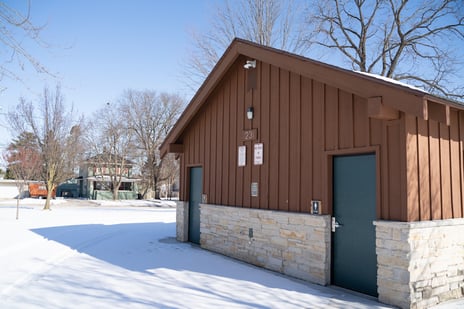
One municipality experienced ongoing vandalism and inappropriate activity at a high-traffic public park. Incidents occurred in parking areas and near the shelter restroom facilities, but the municipality did not have adequate surveillance coverage of the location.
Because incidents were often discovered after the fact, staff had limited information available to identify individuals, review vehicle activity, or determine what happened before and after a reported event.
The municipality needed a surveillance solution that could provide broad coverage of the shelter building and its surrounding areas without requiring an excessive number of individual cameras.
Looking beyond the restroom entrance
Securing a park shelter bathroom involves more than placing a camera directly over the restroom door.
The surrounding environment can provide important context during an investigation. Depending on the location, municipalities may need visibility into:
- Restroom and shelter entrances
- Nearby sidewalks and pedestrian approaches
- Parking lots and vehicle access points
- Gathering spaces around the shelter
- Paths leading into or away from the park
- Areas where individuals may approach or leave the facility
Capturing activity across these areas can help staff understand how an incident developed rather than seeing only what occurred directly outside the building.
The video surveillance solution
To improve visibility, the municipality deployed two complementary camera technologies: the Avigilon™ Unity H6A Dual Head Camera and the Avigilon™ H5A Multisensor Camera.
Each camera addressed a different part of the park environment. Together, they provided broader coverage of the shelter, parking lot and surrounding areas while helping reduce potential blind spots.
Avigilon™ Unity H6A Dual Head Camera
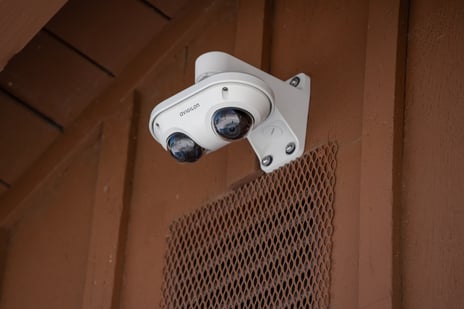
The Avigilon™ Unity H6A Dual Head Camera uses two independently adjustable camera heads within a single device.
For a park shelter application, the two camera heads can be positioned to monitor different areas from the same mounting location. For example, one sensor may provide coverage of a restroom or shelter entrance while the other monitors an adjacent sidewalk, parking area, or approach to the building.
This design helps municipalities:
- Monitor two viewing directions from one camera location
- Improve coverage around the exterior of the shelter
- Reduce blind spots near building corners and entrances
- Limit the number of separate devices mounted on the building
- Capture activity approaching and leaving key areas
The dual-head design is especially useful when the shelter layout requires focused views of multiple areas that cannot be effectively monitored with a single fixed camera.
 .
. 
Avigilon™ H5A Multisensor Camera
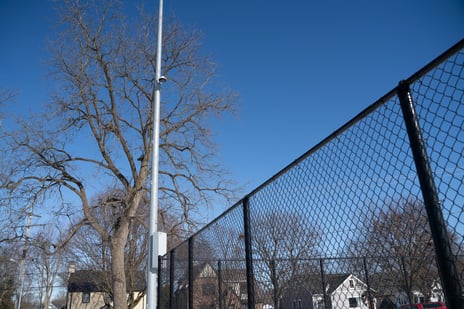
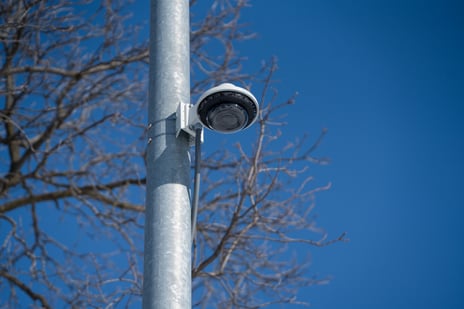
The Avigilon™ H5A Multisensor Camera provides broad, adjustable coverage from a single mounting point.
In this park application, the multisensor camera helped extend surveillance beyond the shelter building to surrounding outdoor areas. Its multiple sensors can be positioned to monitor different directions, making it well suited for parking lots, pedestrian areas, open gathering spaces, and other locations where wide-area visibility is needed.
For parks and recreation departments, a multisensor camera can help:
- Monitor several directions from one installation point
- Provide broader coverage of parking and pedestrian areas
- Reduce gaps between individual camera views
- Track movement across a larger area
- Reduce the number of separate cameras needed for wide-area coverage
This can be especially valuable in public parks where available mounting locations, electrical access, and network connectivity may be limited.
Why two camera types work better together
The H6A Dual Head Camera and H5A Multisensor Camera serve different but complementary purposes.
The dual-head camera provides targeted coverage around the shelter itself, while the multisensor camera provides a wider view of the surrounding park environment. Together, they help capture both the incident area and the activity leading into and away from it.
This coordinated approach can help municipal staff answer important questions after an incident:
- When did the individuals arrive?
- Which direction did they approach from?
- Did they arrive on foot or in a vehicle?
- How long were they in the area?
- Where did they go after leaving the shelter?
- Were other individuals involved?
That broader context can be critical when reviewing vandalism, property damage or other reported activity.
Using video analytics to find relevant activity faster
Modern video surveillance systems do more than record footage. AI-powered video analytics can help operators organize and search video more efficiently by distinguishing between different types of activity and helping staff focus on relevant events.
This can be particularly useful for municipalities managing surveillance across multiple parks and public facilities. Instead of manually reviewing hours of footage, staff can narrow their search based on the approximate time of the incident, the location involved, and the type of activity they are investigating.
Faster video review can help parks staff and public safety personnel establish timelines, identify relevant footage, and respond more effectively when an incident is reported.
The impact of improved park surveillance
The completed system gave the municipality broader visibility into the parking lot, shelter entrances, and surrounding areas.
The solution helps municipal staff and public safety personnel:
- Deter vandalism and unwanted behavior
- Establish more accurate incident timelines
- Identify individuals associated with reported events
- Review vehicles entering and leaving the area
- Improve visibility into pedestrian activity
- Support investigations with recorded video
- Improve overall safety awareness in a high-use public area
Most importantly, the municipality now has greater visibility into what is happening around the shelter rather than relying solely on reports made after an incident has occurred.
Important privacy considerations for park restroom security
Cameras should never be installed inside restrooms, changing areas, or other locations where individuals have a reasonable expectation of privacy.
Surveillance should instead be designed to monitor appropriate exterior areas, such as entrances, exits, parking lots, sidewalks, and the public spaces surrounding the building.
Municipalities should also establish clear policies regarding:
- Camera placement
- Video monitoring signage
- System access
- Video retention
- How recorded footage may be used
Working with an experienced security integrator can help ensure camera coverage supports the municipality’s safety goals while respecting privacy and applicable policies.
Check out smart sensor solutions that assist in detecting vaping, aggression, abnormal noice and safety threats in privacy-sensitive spaces.
Planning security for park shelter bathrooms
Every park has a different layout, and there is no single camera configuration that works for every shelter bathroom.
Before selecting equipment, municipalities should evaluate:
- Where incidents have historically occurred
- How people and vehicles enter and leave the park
- Which areas are obstructed by buildings, trees, or landscaping
- Available mounting locations
- Lighting conditions during the day and at night
- Power and network availability
- How video will be monitored, stored, and reviewed
- Whether the location needs to integrate with an existing municipal security system
A site assessment can help determine whether a dual-head camera, multisensor camera, or combination of camera types provides the most effective coverage.
See the Park Shelter Bathroom Solution
See how one municipality improved visibility around a park shelter restroom using targeted video surveillance.
Explore more public space security examples
Park shelter bathrooms are only one of the public environments municipalities must protect.
BAYCOM’s complete Smarter Security for Public Spaces case study explores 10 real-world security applications involving parks, schools, public transit, municipal facilities, parking structures, libraries and other community spaces.
Download the complete Smarter Security for Public Spaces case study.
Improve visibility across your parks and recreation facilities
Whether your municipality is addressing repeated vandalism at one shelter or planning a larger security upgrade across multiple parks, BAYCOM can help evaluate your facilities and design a solution around your specific risks, infrastructure, and operational needs.
Contact BAYCOM to discuss security solutions for your parks and recreation facilities.
Frequently asked questions
Can security cameras be installed near public park restrooms?
Yes. Security cameras can be installed around the exterior of park shelter bathrooms and other public facilities to improve safety and deter vandalism. Cameras should be positioned to monitor entrances, exits, sidewalks, parking areas, and surrounding public spaces while avoiding locations where individuals have a reasonable expectation of privacy, such as inside restrooms or changing areas.
What types of incidents can security cameras help deter in public parks?
Video surveillance can help discourage a variety of incidents, including:
- Graffiti and vandalism
- Property damage
- After-hours loitering
- Illegal dumping
- Theft
- Trespassing
- Suspicious activity
Visible security cameras can also encourage appropriate behavior by increasing awareness that public areas are being monitored.
Where should security cameras be placed around park shelter bathrooms?
Effective surveillance extends beyond the restroom entrance. Camera placement should provide visibility into areas such as parking lots, sidewalks, trails, shelter entrances, and other locations where people or vehicles enter and leave the park. A site assessment can help determine the best camera locations while minimizing blind spots.
What are the benefits of AI-powered video analytics for municipalities?
AI-powered video analytics help municipal staff quickly locate relevant footage, identify people or vehicles involved in an incident, and reduce the time spent reviewing recorded video. This allows parks departments, public works teams, and public safety agencies to investigate incidents more efficiently and improve overall situational awareness.
How can municipalities reduce vandalism at park facilities?
Reducing vandalism often requires a combination of strategies, including improved lighting, visible security cameras, clear signage, routine maintenance, and regular patrols. A proactive surveillance system can help deter unwanted activity while providing valuable evidence if an incident occurs.
Can one camera monitor multiple areas around a park shelter?
Yes. Technologies such as dual-head and multisensor cameras allow municipalities to monitor multiple directions from a single mounting location. This can improve coverage around park shelters, parking lots, and surrounding public spaces while reducing the number of cameras needed.
How do municipalities determine the right surveillance solution for a park?
Every park has different security needs based on its layout, usage, and history of incidents. A professional site assessment can evaluate factors such as pedestrian traffic, vehicle access, lighting conditions, existing infrastructure, and areas of concern to recommend the most effective surveillance solution.
Can security cameras integrate with an existing municipal security system?
In many cases, yes. Modern video surveillance solutions can often integrate with existing video management software, access control systems, and other security technologies, allowing municipalities to expand coverage while maintaining centralized monitoring and management.