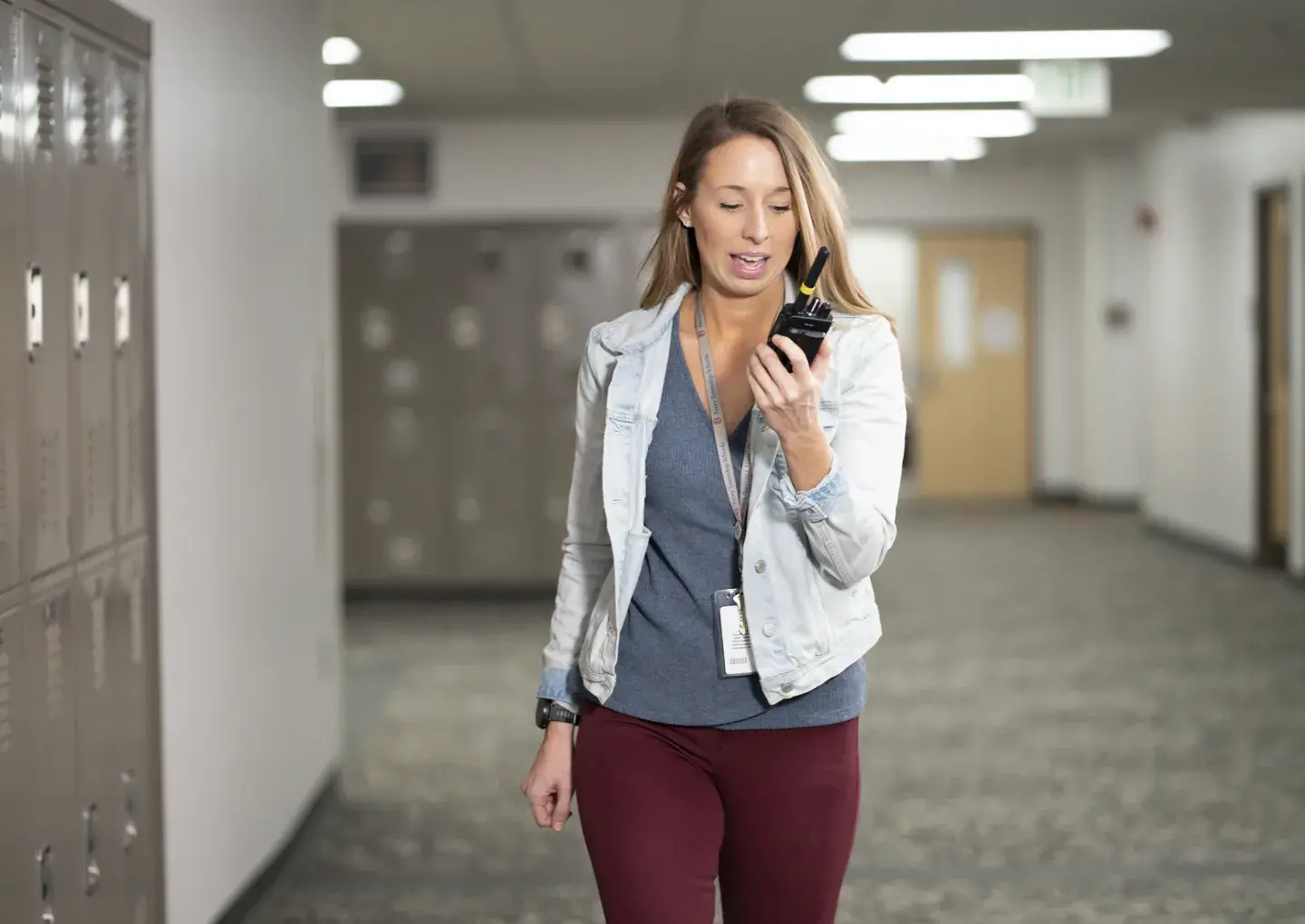
We’ve all heard the dangers of distracted driving from cell phone use. But when the vehicle is a 40-ton tractor-trailer driving down an interstate, the danger reaches another level.
It’s one reason federal law prohibits commercial motor vehicle drivers from holding, dialing, or reaching for a mobile phone while driving. But that didn’t stop a semi driver who was distracted when using his cell phone on a North Carolina highway in the summer of 2024. Three seconds into his call, the driver’s commercial vehicle plowed into a line of slow-moving cars and trucks at 70 mph, resulting in the deaths of five people.1
Sadly, these types of stories are not uncommon. It’s one reason many commercial transport companies equip their drivers with in-vehicle push-to-talk radios.
In this article, you’ll learn about:
- Key rules restricting mobile phone use for commercial drivers
- Penalties for using cell phones while driving commercial vehicles
- The hidden costs of compliance violations
- Compliant push-to-talk radio solutions for commercial fleets
- The first steps to explore compliant two-way radios
VIEW TRANSPORTATION & LOGISTICS COMMUNICATION SOLUTIONS
What key rules restrict mobile phone use for commercial motor vehicle operators?
The Federal Motor Carrier Safety Administration (FMCSA) prohibits drivers of commercial motor vehicles (CMV) from texting or using hand-held mobile telephones while driving. This includes while being temporarily stationary due to traffic, lights, or momentary delays.
CMV drivers are, however, permitted to use hands-free communication equipment while driving, but it must be operable with a single-button touch or voice command. The driver cannot:
- Dial a number
- Read or type messages
- Hold the device in their hand
The driver must also be able to touch any button needed to operate the push-to-talk feature while in a normal seated position with their safety belt fastened.2
What are the penalties for commercial vehicle cell phone use?
Drivers
Drivers can be fined for noncompliance and have their CDL license revoked for repeat offenses.
| Violation of Federal Handheld Mobile Device Rules | Financial Penalty | Driver Qualification Consequence |
|---|---|---|
| First Violation | Up to $2,750 fine | No CDL disqualification required |
| Second Violation | $2,750 fine | Minimum 60-day CDL disqualification |
| Third or Subsequent Violation | $2,750 fine | Minimum 120-day CDL disqualification3 |
If the violation results in an accident, the driver may even face criminal charges in a court of law.
Employers
Drivers who use a cellular phone while driving put their employers at risk. A company may be held liable for the actions of a driver if the driver was fulfilling work obligations at the time of an accident.
Employers can face civil penalties and steep fines up to $11,000 per violation if they require or allow their drivers to use hand-held devices.
Beyond fines and potential CDL disqualification, drivers cited for using a handheld cell phone may be assessed up to 10 points under FMCSA's Compliance, Safety, Accountability (CSA) program. These violations can negatively impact the motor carrier's Safety Measurement System (SMS) score, which is used to identify and prioritize carriers for safety interventions.3
The hidden costs of distracted driving
Cell phone violations may extend far beyond regulatory penalties, contributing to:
- Increased insurance premiums
- Legal expenses
- Litigation exposure
- Equipment damage
- Cargo loss
- Missed deliveries
- Reputational harm
For fleets operating on tight margins, even a single violation or serious incident can have lasting financial consequences, and may cost more than a year of radio service.
Compliant push-to-talk communication systems for commercial carriers
Maintaining communications with off-site personnel is critical for logistics operations. Digital two-way radios with one-touch access provide an effective way for employers to communicate with their drivers while also keeping them safe and legal.
Push-to-talk two-way radios are not subject to the same regulations that govern cellular phone usage.
Which two-way radio is best for commercial drivers?
The best two-way radio for commercial drivers depends on where the work happens. For most drivers who spend the majority of their day behind the wheel, a mobile radio installed in the vehicle is the preferred choice. Drivers who regularly leave their vehicles to make deliveries, inspect equipment, or work around job sites may benefit from a portable radio—or a combination of both.
Mobile radios: Best for drivers who spend most of the day on the road
For transportation fleets, utility vehicles, construction trucks, and service vehicles, a mobile radio is typically the best solution. Installed directly in the vehicle, mobile radios provide:
- Stronger coverage with higher transmit power and an external antenna
- Reliable, vehicle-powered operation without worrying about battery life
- Loud, clear audio that cuts through road and engine noise
- Hands-free communication options for safer operation
- Consistent communication with dispatch and other drivers throughout the workday
BAYCOM offers several mobile radios to fit different fleet needs, including:
- MOTOTRBO™ XPR™ 2500 – An excellent choice for fleets looking for reliable day-to-day digital communications with support for 128 channels, IP Site Connect, and Capacity Plus.
- MOTOTRBO™ XPR™ 5000e Series – Designed for organizations that need advanced capabilities such as integrated Bluetooth®, talk group scanning, and flexible dash or remote mounting options.
- TLK 150 WAVE PTX™ Mobile Radio – Ideal for fleets operating across large geographic areas. Using nationwide broadband connectivity instead of traditional radio infrastructure, it provides private and group push-to-talk, GPS location tracking, Wi-Fi, Bluetooth®, and over-the-air device management.
Portable radios: Best for drivers who work outside the vehicle
Portable radios from Motorola Solutions are ideal for employees who frequently step away from the cab, such as delivery drivers, warehouse personnel, yard crews, field supervisors, and utility workers. They provide:
- Reliable communication while unloading, inspecting equipment, or working on-site
- Lightweight, easy-to-carry designs
- Instant communication without returning to the vehicle
- Flexibility for teams working across facilities or job sites
BAYCOM recommends the following portable radios for commercial operations:
- MOTOTRBO™ R7 – Built for demanding environments, the R7 delivers exceptionally loud, clear audio with advanced noise suppression, long battery life, and rugged durability. It's an excellent choice for transportation, logistics, utilities, construction, and other industries where reliable communication is essential.
- MOTOTRBO™ R5 – The R5 provides dependable digital communications in a compact, easy-to-use design. Featuring clear audio, extended battery life, and durable construction, it's ideal for fleets, warehouse teams, delivery drivers, and field personnel who need reliable communication throughout the workday.
Many organizations use both
For many commercial operations, the best solution isn't choosing one over the other—it's using both. A driver may rely on a mobile radio while traveling between locations and switch to a portable radio when working outside the vehicle. This approach keeps communication uninterrupted throughout the workday, improving coordination, safety, and operational efficiency.
Whether your team is transporting goods, servicing customers, managing utility infrastructure, or coordinating field operations, selecting the right radio solution starts with understanding how and where your employees work.
It’s important to note that vehicle-mounted systems are designed around instant push-to-talk voice communications, allowing drivers to communicate quickly without the distractions associated with dialing, texting, or navigating smartphone applications.
These advanced radio systems may also feature GPS monitoring, helping dispatchers and fleet managers:
- Track vehicle locations in real time
- Improve routing decisions
- Enhance driver safety
- Respond to changing road conditions or construction
- Improve accountability
- Maintain greater operational oversight across their fleet
Qualified providers like BAYCOM can customize radio systems to ensure compliance while still allowing drivers to easily communicate with command centers and logistics operations.
Not sure which radio is right for your operation? Use BAYCOM's Find Your Radio Solution tool to compare mobile and portable radios based on how and where your employees work. You can also connect with one of our experts for personalized recommendations on the best radios for your fleet.
Why are two-way radios allowed while driving commercial vehicles?
Unlike smartphones, two-way radios are designed for brief, one-touch voice communications. FMCSA's restrictions specifically target activities that require drivers to hold, dial, text, browse, or otherwise interact extensively with a mobile device. Properly installed push-to-talk radio systems can be operated with a single touch while maintaining control of the vehicle, making them a compliant communication option for commercial drivers.
Next steps for compliant two-way radio solutions
Maintaining reliable communications while reducing risk is a constant challenge. Digital push-to-talk radio systems from BAYCOM provide a practical solution that helps fleets:
- Stay connected
- Support driver safety
- Reduce liability exposure
- Maintain compliance with FMCSA regulations
As distracted driving enforcement continues to increase, many fleet operators are turning to purpose-built radio systems as a safer alternative to mobile phones behind the wheel. At BAYCOM, we’ve been helping commercial carriers for decades and are ready to help you, too. Contact our team today to talk through your needs. We’ll do a thorough assessment and develop a robust, compliant plan with safety first.
Sources:
- The News & Observer. Truck driver was on his phone during I-95 crash that killed 5, NTSB says. (August 2025)
- Federal Motor Carrier Safety Administration. Mobile Phone Restrictions Fact Sheet. (2013)
- Federal Motor Carrier Safety Administration. 6.3.8 Electronic Devices/Mobile Phones (392.80—392.82)
FAQs: Radio communication for commercial drivers
Can CDL drivers legally use two-way radios while driving?
Yes. FMCSA regulations prohibit texting and hand-held cell phone use while driving, but drivers may use compliant push-to-talk radio systems that can be operated with a single touch while remaining properly seated and belted.
What is considered illegal cell phone use for commercial drivers?
Commercial drivers may not hold a mobile phone, dial more than a single button, read or send text messages, or reach for a device in a way that requires them to leave their normal driving position.
What penalties can drivers face for violating FMCSA cell phone rules?
Drivers may face fines of up to $2,750 per violation, CDL disqualification for repeat offenses, CSA points, and potentially criminal charges if distracted driving results in a serious accident.
Can employers be fined if drivers use cell phones while driving?
Yes. Employers that require or allow drivers to use hand-held mobile devices while driving may face civil penalties of up to $11,000 per violation, along with increased liability exposure.
What are the benefits of digital push-to-talk radios for trucking fleets?
Digital radio systems provide instant communications without dialing or texting, helping fleets improve driver safety, maintain FMCSA compliance, coordinate operations, track vehicles with GPS, and respond quickly to changing conditions on the road.